
Is There an Official Seminole County Warrant List?
Not a single public one. The Sheriff's site has investigative and custody tools, but the pages reviewed did not include a standalone active-warrant search for the public. That is common in Florida, where warrant lists can tip off the subject and interfere with an arrest. So the honest answer is that you use official court and jail channels to find the clues, then confirm directly.
This matters because many third-party "warrant search" sites promise a list they cannot deliver. Stick to the Clerk and the Sheriff, and call the court when you need a definite answer.
Searching the Clerk Criminal Portal
The Clerk's criminal case portal is the best starting point. A warrant usually ties to a criminal case, a missed hearing, or a probation matter, and those show up in the case record. Search by name, date of birth, or case number, and look for open cases, failure-to-appear entries, or a capias. The portal will not show confidential cases in a name search.
The criminal case search, shown below from the Seminole criminal case portal, is where most warrant clues appear.
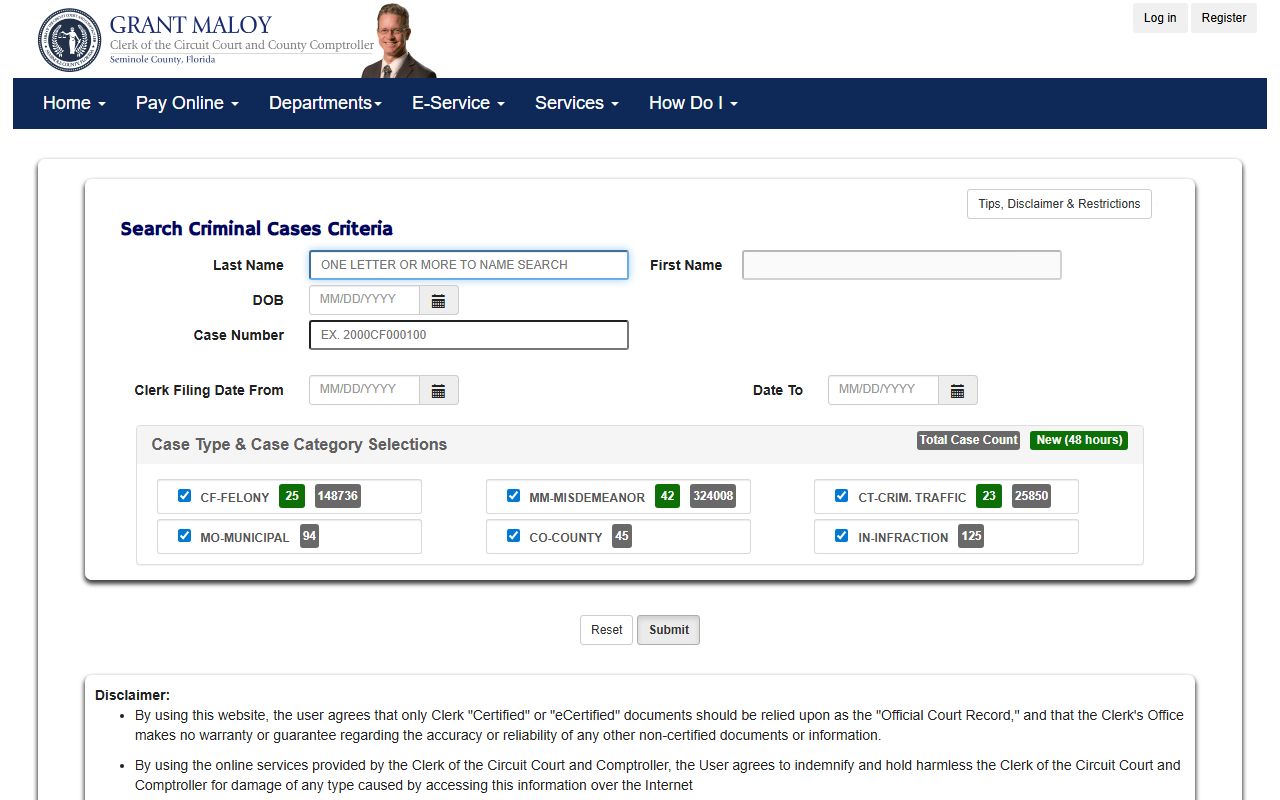
| Field | Type | Required | Notes |
|---|---|---|---|
| Last Name | Text | No | Business names allowed. |
| First Name | Text | No | Narrows the result. |
| Date of Birth | Date | No | MM/DD/YYYY. |
| Case Number | Text | No | Letters and numbers only. |
| Filing Date From / To | Date | No | MM/DD/YYYY range. |
Checking the Sheriff Custody Portal
If a person may already be booked, the Sheriff's custody portal can confirm it. The custody profile lists charges, the court case number, the next court date, bond type, and bond amount. After an arrest on a warrant, the charge and bond show there. The portal warns that a $0.00 bond can mean no bond is due, the person was released, or the person was sentenced.
For the full custody search and its fields, see the Seminole County inmate records page.
Types of Warrants in Seminole County
Warrants are not all the same, and the type changes how you handle it. Some require an arrest, while others can be addressed by motion, bond, or a hearing.
- Arrest warrant - issued by a judge on probable cause that a crime occurred.
- Bench warrant or capias - issued for a missed court date, contempt, or noncompliance.
- Violation-of-probation warrant - issued when a probation breach is alleged.
- Search warrant - authorizes a search of a place or person, often sealed until executed.
- Out-of-county or out-of-state warrant - can lead to a hold or an extradition decision.
A capias in a family or child-support case can show up in the court record too. The label on the docket tells you which kind you are dealing with.
Failure to Appear and Bench Warrants
The most common warrant is the one for a missed court date. When a person does not show for a required hearing, the judge can issue a bench warrant or capias. The case docket usually shows the missed event and the order that followed. First appearances for new arrests are held at the John E. Polk Correctional Facility in courtroom J-2, typically within 24 to 48 hours.
If you missed a date, do not wait. A lawyer or the court can sometimes set the matter for a quick hearing and lift the warrant before an arrest.
How to Resolve a Seminole County Warrant
Clearing a warrant takes a careful, official path. Acting on a third-party site can leave you worse off. Follow the court's process instead.
- Search the Clerk criminal portal by name, date of birth, and case number for open cases and missed dates.
- Check the Sheriff custody portal in case the person is already booked.
- Call counsel or the Clerk to confirm court dates and case status.
- Speak with a criminal defense attorney or the court before appearing.
- If booked, review the custody profile for charge, bond type, bond amount, and the next court date.
- For bond, follow the Sheriff's Posting Bond page and confirm whether any charge is no-bond.
Note: Some warrants require arrest and booking, while others can be handled by motion, bond, or hearing, so confirm before you act.
What a Warrant or Booking Record Shows
After an arrest on a warrant, the custody charge grid carries the key fields. The booking record is the closest thing to a warrant record the public can view.
| Field | What It Shows |
|---|---|
| Charge Description | The offense behind the warrant or booking. |
| Class | Felony or misdemeanor level. |
| Court Case Number | The Clerk file tied to the charge. |
| Bond Type / Amount | The bond set, or a no-bond status. |
| Next Court Date | The next scheduled hearing. |
| Disposition | The current outcome of the charge. |
Bond on a Seminole County Warrant
Bond is often the first question after a warrant. For many arrest warrants, a judge sets an initial bond from a schedule fixed by administrative order, and the person can post it to be released while the case moves ahead. The amount depends on the charge and the person's history. A bench warrant for a missed date may set a bond, or it may require a court appearance to address.
The custody profile is where the real number shows. It lists bond type and amount per charge. The portal warns that if any single charge reads no bond, the person is not bondable until a judge changes it. So one no-bond line can hold someone even when every other charge has a set bond. Confirm the full picture before paying a bondsman or the jail.
For a sentenced person, the bond field may read $0.00 even though no release is coming. Read the status line, not just the dollar amount.
Why a Warrant Search May Show Nothing
An empty result is not proof. There are several honest reasons a search comes back blank. The case may be confidential and pulled from name search. The spelling or date range may be off. The warrant may be too new to be indexed, since dockets can lag the docket date by several days. A search warrant may be sealed until it is executed.
When the answer truly matters, such as before travel or a job, do not rely on a blank screen. Call the Clerk or the court, or have a lawyer check. The official phone confirmation beats any guess from a search page.
Sealed Warrants and Confidential Cases
Some warrants stay out of public view. A search warrant is often sealed until it is executed. A sealed or confidential case will not appear in a public name search at all. That is why a clean search result does not always prove there is no warrant. When the stakes are high, confirm with the court rather than relying on an empty result. A short call to the Clerk or a quick check by counsel can settle the question that an online search cannot. Treating an empty result as a final answer is the mistake that catches people off guard later.
For related criminal case help, see Seminole County criminal records and the court records page.