
How to Search Seminole County Court Records
The official starting point is the Clerk's "Search for a Court Case" page. It links every public portal in one place. From there you pick the right tool: Civil Cases for civil, family, and probate matters; Criminal Cases for felonies and misdemeanors; Traffic Citations for tickets; Official Records for recorded documents; and Court Events for hearing calendars. Each portal lets you search by party name, case number, or a date range. Business names go in the last-name field. The Clerk warns that most cases are online from 1985, scanned document images start with open cases from 2005, and each search returns at most 500 records.
Have a few things ready before you start. A full name with the correct spelling helps. A case number is better still, because it pulls one file fast. If you only have a date, set a tight range so the search does not time out.
The Clerk's court search landing page collects all of these tools, as shown on the Seminole Clerk court search page. The screenshot below shows how the official menu groups civil, criminal, traffic, and official records in one spot.
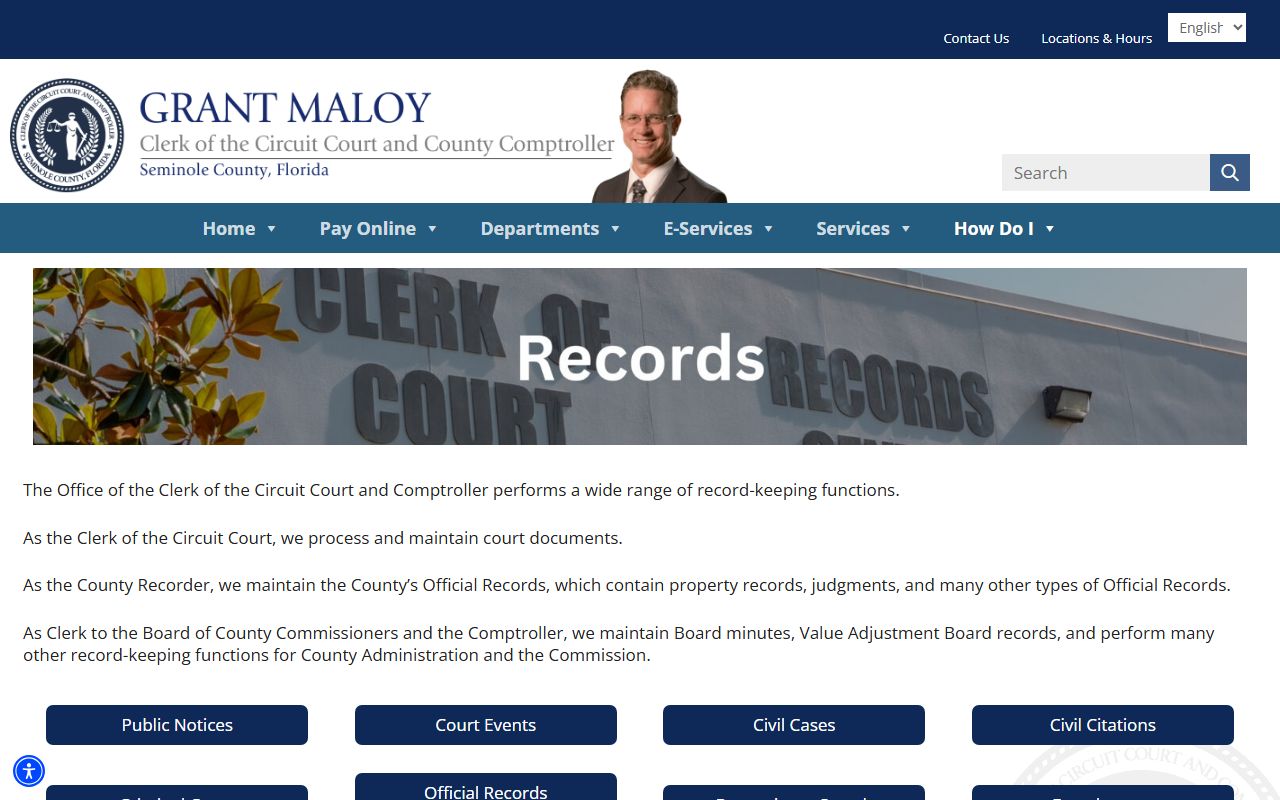
Use that landing page as your hub so you do not land on the wrong portal and miss a case.
- Open the Clerk's Search for a Court Case page and pick the portal that matches your record type.
- Enter a party name or, for a faster result, the case number.
- Narrow the search by case category and a filing-date range.
- Review the docket entries and any document images that are available.
- Request a certified or eCertified copy from the Clerk if you need an official record.
Note: confidential cases do not appear in public name searches, so a blank result does not always mean no case exists.
The Seminole County Judicial System
Florida runs one unified court system. At the top is the Supreme Court of Florida. Below it are six District Courts of Appeal that hear most appeals. Then come 20 circuit courts and 67 county courts that do the trial work. Seminole County belongs to the Eighteenth Judicial Circuit, which it shares with Brevard County. The circuit was created by the Legislature in 1967.
The split between the two trial courts is simple to learn. The Circuit Court is the court of general jurisdiction. It hears felonies, family law, probate, guardianship, juvenile cases, and civil suits over $50,000. The County Court is the limited court. It hears misdemeanors, traffic, small claims, evictions, and county civil claims up to the statutory limit. You can read more on the Seminole County Circuit Court page and the Seminole County Court page.
Case flow: County Court › Circuit Court › District Court of Appeal › Supreme Court of Florida
| Court | Jurisdiction | Case Types |
|---|---|---|
| Circuit Court | General trial court | Felonies, family, probate, juvenile, civil over $50,000, injunctions |
| County Court | Limited trial court | Misdemeanors, traffic, small claims, evictions, county civil |
| District Court of Appeal | Intermediate appeals | Appeals from circuit court and some agency rulings |
| Supreme Court of Florida | Highest state court | Final review and court administration statewide |
The Florida Courts site lays out this hierarchy in full, and the official Florida court structure page maps each level. The image below shows that statewide structure.
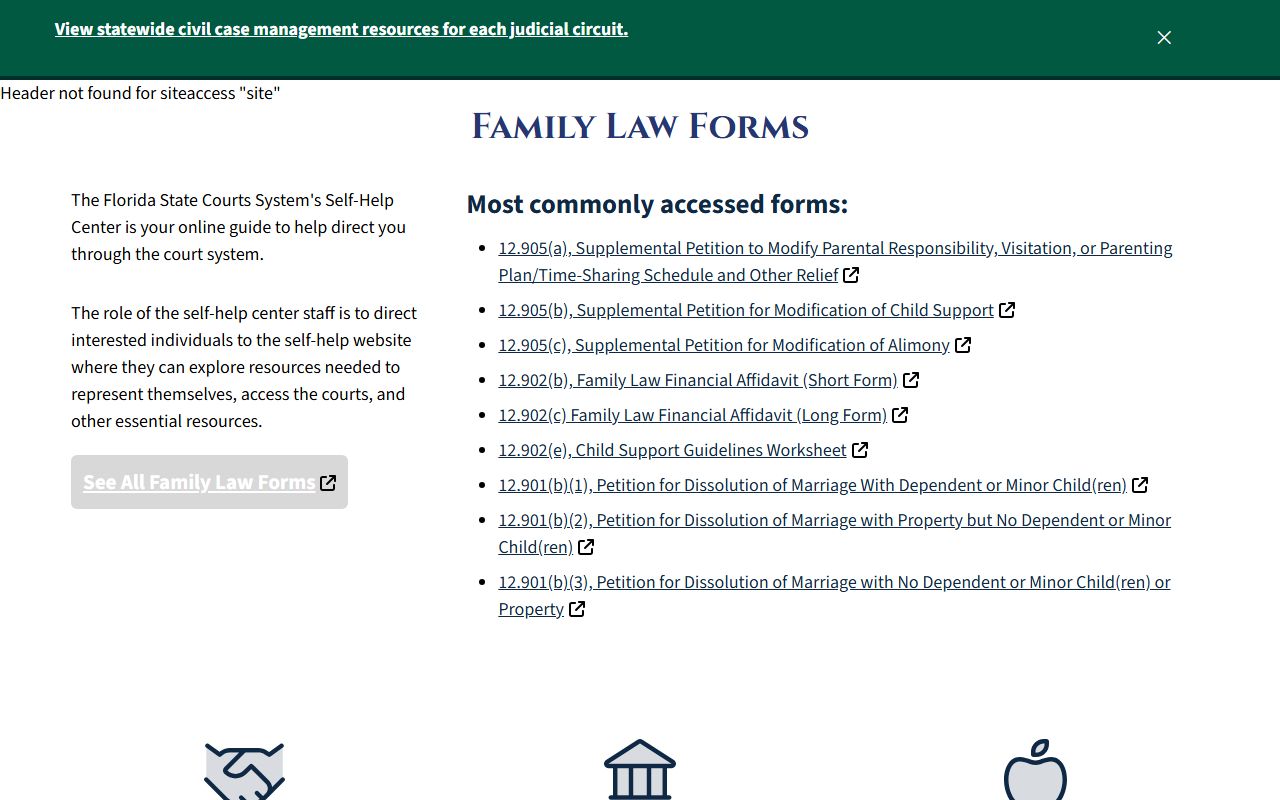
Knowing the level a case sits on tells you which portal and which counter to use.
Seminole County Courthouses
Seminole's justice campus is packed onto Eslinger Way in Sanford. The Criminal Justice Center at 101 Eslinger Way is the current full-service civil and criminal court location for many Clerk services. Injunctions and administration sit next door at the Justice James E.C. Perry Annex. Juvenile and probate services run from the Juvenile Justice Center at 190 Eslinger Way. Official Records and passports are at the Records Center on East Lake Mary Boulevard. During renovations at the Criminal Justice Center, Tuesday through Thursday traffic hearings moved downtown to 301 North Park Avenue, while Friday hearings stay at Eslinger Way.
Records Center & Passports
1750 East Lake Mary Boulevard
Sanford, FL 32773
407-665-4405
The Clerk's locations page warns visitors not to park in the Sanford City Hall lot for courthouse business, because tickets are being written there. Confirm the right building before any hearing.
Types of Court Records Available in Seminole County
The Clerk keeps a wide range of court records. Each type has its own portal or category, and each ties back to either the Circuit Court or the County Court. Small claims cover claims under $8,000. County civil runs from $8,001 to $49,999. Circuit civil starts above $50,000.
These are the main record groups you can look up in Seminole County.
- Criminal records - felony, misdemeanor, and criminal traffic cases filed with the Clerk.
- Civil records - contract, foreclosure, eviction, injury, and other money or property disputes.
- Family and divorce records - dissolution, support, paternity, and custody filings.
- Probate records - estates, wills, guardianship, and trust matters.
- Traffic records - citations, hearings, school elections, and payment history.
Juvenile, dependency, and adoption matters also exist, but Florida law keeps most of them out of public search.
What Seminole County Court Records Show
A court record is more than a name and a charge. Each file holds a set of fields that track the case from start to finish. Case numbers follow a pattern, such as a year, a division code like CF for felony, a sequence number, and a suffix letter. The criminal portal even shows a sample format of 2000CF000100. Knowing the fields helps you read a docket without guessing.
| Field | What It Shows |
|---|---|
| Case Number | Year, division code, sequence number, and suffix that identify the file. |
| Filing Date | The date the Clerk opened the case or accepted a document. |
| Parties | Plaintiffs, defendants, petitioners, respondents, and business names. |
| Charges / Cause | The crime charged or the civil claim that started the case. |
| Disposition | The current or final outcome of each charge or claim. |
| Judgment / Sentence | The court's final ruling, award, or sentence. |
Only Clerk certified or eCertified documents count as the official record. The free online view is great for research, but the Clerk does not warrant non-certified data.
Public Access Laws for Seminole County Court Records
Florida starts from broad public access. Chapter 119, the Public Records Act, gives you the right to inspect and copy records that agencies make or receive on official business. Court records also follow judicial-branch rules, and the Clerk works under Chapter 28. The Clerk's portals reflect this balance: wide indexes are open, but confidential cases are pulled from name search, and certified copies stand as the official record. Many exemptions apply, from juvenile and adoption files to protected addresses and sealed criminal histories.
Key Statutes:
Florida Statutes Chapter 119 - the Public Records Act, which sets the right to inspect and copy agency records unless an exemption applies.
Florida Statutes Chapter 28 - defines the Clerk's duties and the fees for copies and certification.
Florida Statutes 943.0585 and 943.059 - govern the court-ordered expunction and sealing of criminal history records.
Florida Statutes Chapter 985 - keeps most juvenile records out of ordinary public access.
More detail sits on the Seminole County public records page.
Records That Are Restricted or Confidential
Not every case is open. Juvenile delinquency, dependency, adoption, and many mental-health matters are confidential by statute. Sealed and expunged criminal records drop out of public view once a court order is processed. Protected personal data, such as the home address of a covered officer or judge, can be removed from Official Records under section 119.071. The Clerk's portals simply return nothing on a confidential case in a name search.
Getting access to a sealed file usually takes statutory authority or a court order. A party, an attorney, a prosecutor, or a law enforcement agency may have rights that the general public does not. For protected Official Records, the Clerk accepts a notarized request by mail or at the Records Center, or by email to officialrecords@seminoleclerk.org.
Specialty Courts in Seminole County
Seminole runs a Veterans Treatment Court. It began as a pilot in 2012 with County Judge John L. Woodard, III presiding. The court steers eligible justice-involved veterans into treatment instead of the usual path. Participants get coordinated court dates, treatment, drug screening, a mentor, and probation supervision across three phases: assessment and stabilization, treatment, and aftercare. Most non-violent, non-traffic third-degree felony and misdemeanor cases can qualify, though drug sale and delivery charges cannot.
The program is voluntary, and no applicant has a right to admission. A participant enters a plea, and sentencing is deferred. After success, the plea is withdrawn and the State Attorney drops the charge by nolle prosequi. The Eighteenth Circuit's Veterans Treatment Court page lists the criteria and contacts, as the image below shows.
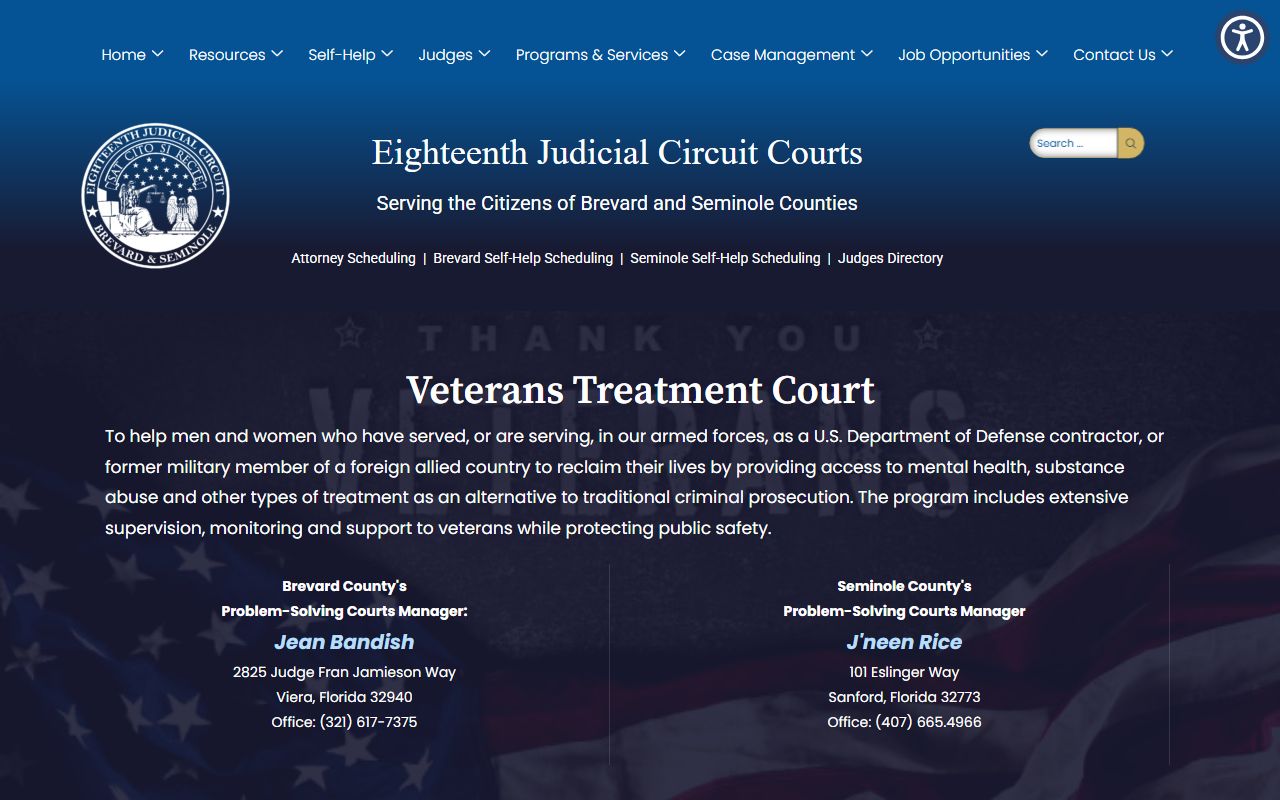
The program contact is J'neen Rice, Problem-Solving Courts Manager, at 407-665-4966.
Seminole County Sheriff and Jail
The Seminole County Sheriff's Office is at 100 Eslinger Way in Sanford, and Dennis M. Lemma is the current sheriff. The agency runs the John E. Polk Correctional Facility at 211 Eslinger Way, where most county arrests are booked. A public custody portal lets you search current inmates by name and view booking details, bond, and the next court date. First appearance hearings are held at the jail in courtroom J-2, usually within 24 to 48 hours of arrest.
The Sheriff's home page, shown below, links the jail, records requests, and the sex offender search through the Seminole County Sheriff's Office site.
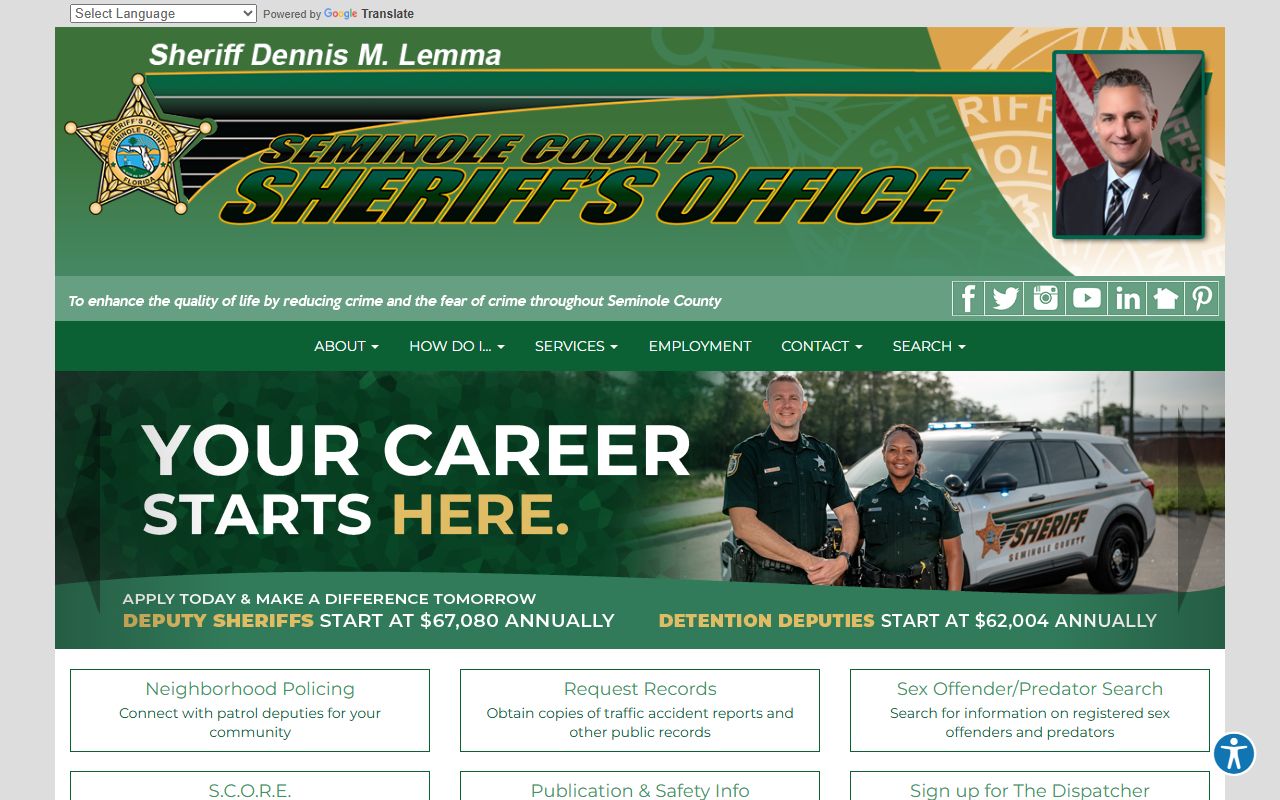
For the full roster details, see Seminole County inmate records, and for active warrants check warrant records.
Marriage, Divorce, and Probate Records
The Clerk issues marriage licenses and records the documents that follow. During the Criminal Justice Center work, wedding ceremonies moved to the Casselberry Branch on Wilshire Boulevard. Divorce, or dissolution of marriage, is a Circuit Court family case and is searched through the civil portal. Probate runs from the Juvenile Justice Center at 190 Eslinger Way. See marriage and divorce records and probate records for the full process.
- Testator
- A person who makes a will.
- Executor
- The person named to carry out a will, also called a personal representative in Florida.
- Guardianship
- A court process that names someone to manage the affairs of a minor or an incapacitated adult.
Seminole County Court Records Fees
Fees depend on the record and the service. Some are set by statute and some by the Clerk's schedule. The items below come from official Seminole sources. Plain copy and filing fees change, so confirm the current amount on the Clerk's fee schedule before you pay.
| Item | Amount |
|---|---|
| Certification add-on per official-record document | $2.00 |
| Traffic proof-of-compliance dismissal fee | $10.00 |
| Unsafe vehicle correction (with certified affidavit) | $96.00 |
| Child-restraint class election court costs | $20.00 |
| Value Adjustment Board single petition | $50.00 |
The Clerk's Official Records Order Form confirms the $2.00 per-document certification add-on.
How to Interpret Seminole County Court Records
Court files use shorthand. A charge is not a conviction. The arrest record only shows what police booked, while the disposition shows how the case ended. A case marked "nolle prossed" means the prosecutor dropped it. "Dismissed with prejudice" means it cannot be refiled. "Adjudication withheld" means the judge did not enter a formal conviction. The criminal categories themselves tell you the court: CF is a felony in Circuit Court, while MM, CT, CO, MO, and IN are county-level matters.
If a docket entry seems off, the safest move is to pull the certified record or call the Clerk. The Sheriff's custody data and the Clerk's case data are two different files, and they update on their own schedules.
Accuracy and Record Limitations
Online records lag real life. The Clerk warns that dockets may not show up for several days after the docket date because of indexing and review. Scanned images exist only for open cases from 2005 forward, and most case indexes start in 1985. A broad name search can hit the 500-record cap or trip a CAPTCHA after 20 requests in an hour.
Note: If a hearing happened today or a paper was just filed, wait a few business days or call the Clerk before you assume nothing was filed.
History of Seminole County Courts
The Eighteenth Judicial Circuit was created in 1967 and joins Brevard and Seminole Counties. Before the 1972 statewide court reform, the area used many court types, such as the Court of Record, Magistrate's Court, County Judge's Courts, Justice of the Peace Courts, and Small Claims Court. That history matters for old records, because an old docket may name a court that no longer exists. After 1972, Florida settled on the circuit and county court model still in use today. The Justice James E.C. Perry Annex is named for a former circuit judge who later joined the Florida Supreme Court.
Frequently Asked Questions
How do I search Seminole County court records online?
Start at the Clerk's Search for a Court Case page and pick the portal that fits. Use Civil Cases for civil, family, and probate; Criminal Cases for felonies and misdemeanors; and Traffic Citations for tickets. You can search by name, case number, or date range. Remember that most records begin in 1985 and that each search caps at 500 results.
Are the online records official?
No. The Clerk says only certified or eCertified documents count as the official court record. The free portal is fine for research, case numbers, and dockets, but the Clerk does not guarantee non-certified data. For court or legal use, request a certified copy.
Why can't I find a case by name?
Name searches skip confidential cases. You may also have the wrong portal, spelling, or date range. Try a partial name, add a date range, and check that business names are typed in the last-name field. Juvenile, adoption, sealed, or expunged cases will not show.
More answers sit on the Seminole County court records FAQ page.