
The Florida Public Records Act
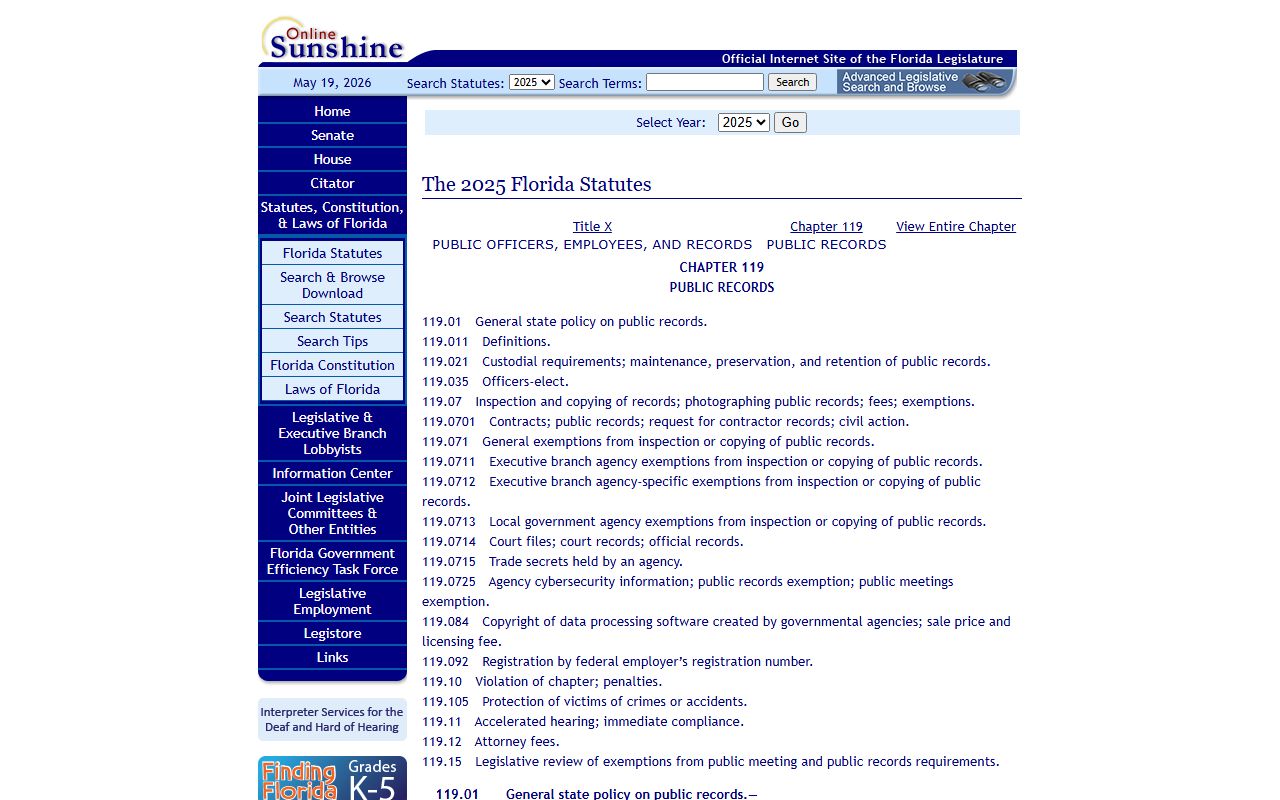
Florida starts from broad access. Chapter 119, the Public Records Act, gives the public the right to inspect and copy records that agencies make or receive on official business, unless a specific exemption applies. The law also covers fees, the custodian's duties, and enforcement by civil action. For Seminole, Chapter 119 underlies sheriff records, clerk administrative records, official records, and many county records, while court records also follow separate judicial-branch rules.
You can read the full text on the Florida Statutes Chapter 119 page, shown below.
Clerk Records Versus Sheriff Records
The biggest mistake is asking the wrong office. The Clerk and the Sheriff hold different records, and a request to the wrong one comes back empty. The Clerk keeps court files, recorded official records, citations, and certified court copies. The Sheriff keeps incident reports, crash reports the agency holds, and jail records. Asking each custodian for what it actually keeps saves weeks.
| Custodian | Records It Holds |
|---|---|
| Clerk of the Circuit Court | Court files, official records, citations, certified copies. |
| Sheriff's Office | Incident reports, crash reports, jail and booking records. |
| State Attorney | Prosecution files subject to release. |
| FDLE | Statewide criminal history and sex offender registry. |
| PACER | Federal court records. |
This source routing keeps you from asking the wrong custodian and then assuming the record does not exist.
Seminole County Official Records
The Clerk is also the County Recorder. Official Records hold recorded documents that go far beyond court cases: deeds, mortgages, liens, notices of commencement, declarations, final judgments, military discharges, death certificates, probate documents, plats, and maps. These are searched through the Clerk's Official Records system, separate from the court case portals.
The Official Records department page, shown below from the Seminole Official Records page, describes recorded document types and eRecording.
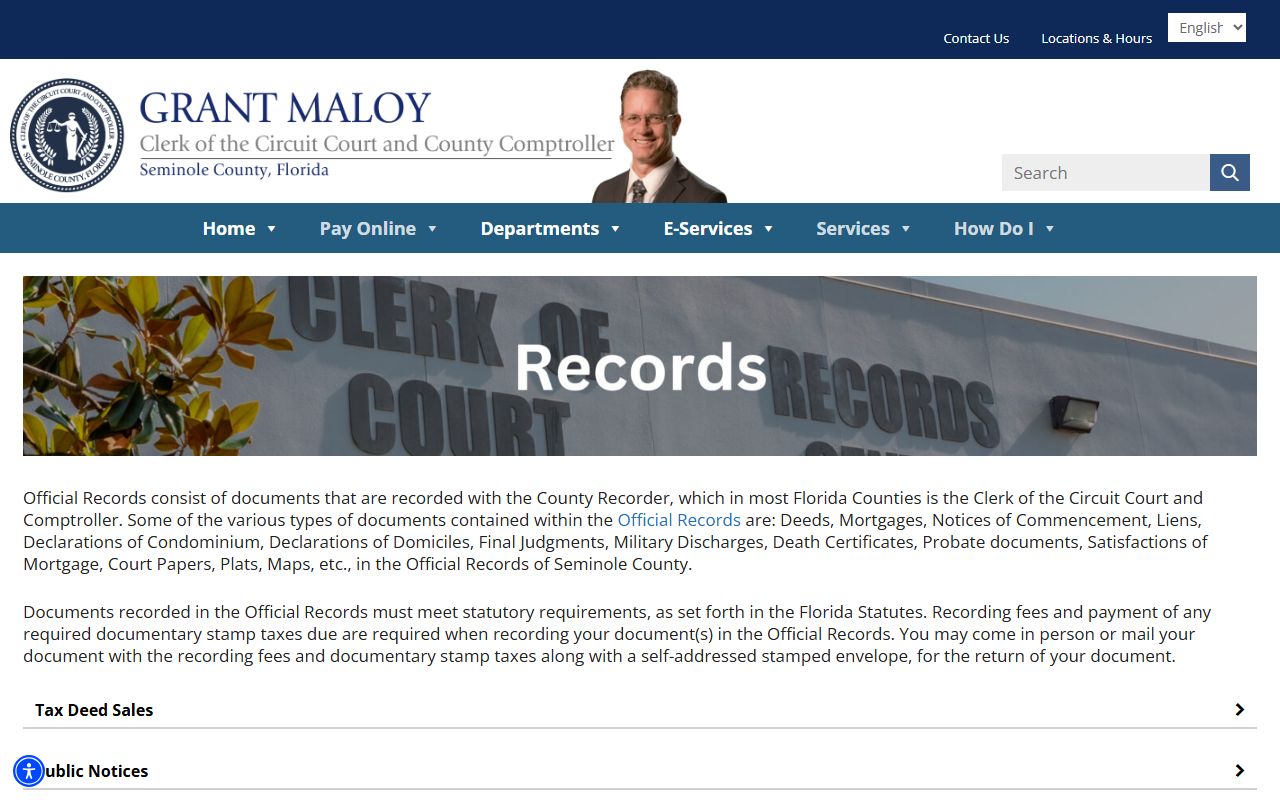
Recorded documents can be eRecorded through approved vendors, and the Clerk says documents are usually recorded within 24 to 72 hours.
How to File a Public Records Request
Filing a request is straightforward once you know the custodian. You do not have to say why you want a record, and you do not need a special form for most requests. The steps below keep it simple.
- Identify which office holds the record you need.
- Describe the record clearly, with names, dates, or a case number.
- Send the request to that custodian by its preferred channel.
- Ask for the fee estimate before copying begins.
- Pay the fee and receive the records or schedule an inspection.
For sheriff-created records, the Sheriff uses a GovQA request system that is separate from the Clerk's case and official-records tools.
Confidentiality Requests for Official Records
Some people can ask the Clerk to remove protected information from Official Records. The Clerk's Request for Confidentiality form is tied to section 119.071 and covers a long list of protected occupations and relationships, from law enforcement officers to judges and certain family members. The form must be notarized, and the requester swears they qualify.
| Form Field | Detail |
|---|---|
| Requestor Type | Individual, spouse, or child. |
| Service Status | Currently serves as, or formerly served as. |
| Eligible Occupation | Checklist of protected classes under section 119.071. |
| Identifying Information | Name, address, and contact fields. |
| Signature and Notary | Sworn statement with a required notary block. |
Requests go to the Official Records Department by mail or in person at the Records Center, or by email to officialrecords@seminoleclerk.org.
Fees and Certified Copies
Public records carry copy and certification fees. Florida law allows agencies to charge for copies and, for extensive requests, a special service charge for staff time. The Clerk's certification add-on for an official-record document is $2.00 per document. Plain copy fees and search fees should be confirmed on the current schedule.
| Item | Amount |
|---|---|
| Certification add-on per official-record document | $2.00 |
| Plain copy fee | Confirm on the Clerk records-management schedule. |
| Extensive-request service charge | Allowed under Chapter 119 for significant staff time. |
eRecording and Ineligible Documents
The Clerk lets many documents be eRecorded through approved vendors, which removes the need to mail or hand-deliver paper. The Official Records page says eRecording lets you track a document and that recording usually happens within 24 to 72 hours. The Clerk lists best practices for submissions, such as 300 DPI scans, clear images, correct document types, and indexing names in last-name, first-name order.
Some documents cannot be eRecorded and must be mailed or brought to the Records Center. The list includes a notice of contest of lien, a notice of contest of bond, a notice of homestead, a transfer of lien to security by bond or cash, a transfer of judgment, and a notice of marketable title when a certificate of service is required. Knowing this avoids a rejected submission.
Response Times and Inspection
Florida law does not set a fixed deadline in days, but it requires custodians to respond in good faith and produce records within a reasonable time. A simple request is often filled quickly. A broad or complex request can take longer and may carry a service charge for the staff time involved. You can ask to inspect records in person rather than buy copies, which can save money on a large file. Narrowing a request to the exact dates or names you need also speeds the response and trims the cost.
If a custodian denies access to a record that is not exempt, Florida law provides remedies through a civil action. For court records, though, sealing and access disputes go through the case file rather than a public-records demand, since the judicial branch has its own rules.
Exempt and Confidential Records
Open access has limits. Florida law exempts a long list of records: juvenile, adoption, and dependency files; mental-health clinical records; victim-identifying information; protected addresses under section 119.071; social security and financial account numbers; and sealed or expunged criminal histories. The Clerk's portals reflect this by hiding confidential cases from name search.
When a record is exempt, the custodian can withhold or redact it. For court records, sealing and access disputes usually require motion practice in the case rather than a simple records request.
Statewide and Federal Records
Some records sit above the county level. A statewide criminal history comes from FDLE, not the Clerk. State prison and supervision records come from the Florida Department of Corrections. Federal court records come from PACER, and federal inmate records from the Bureau of Prisons. A crash report originates with the investigating agency or the state motor-vehicle office, separate from any traffic court case.
For the court-record side of these searches, see Seminole County court records and criminal records.