
How to Search Seminole County Criminal Records
The Clerk's criminal case portal is the main tool for court records. It covers felonies, misdemeanors, and criminal traffic filed in Seminole County. You can search by last name, first name, date of birth, or case number, and you can set a filing-date range. Six category boxes let you narrow the search. Business names go in the last-name field, and confidential cases will not appear in a name search.
For jail and booking status, the Sheriff's custody portal is the better tool. Use the two together: the Sheriff for who is in custody right now, and the Clerk for the full case and its outcome.
The criminal case search, shown below from the Seminole criminal case portal, lays out the name, date, and category fields.
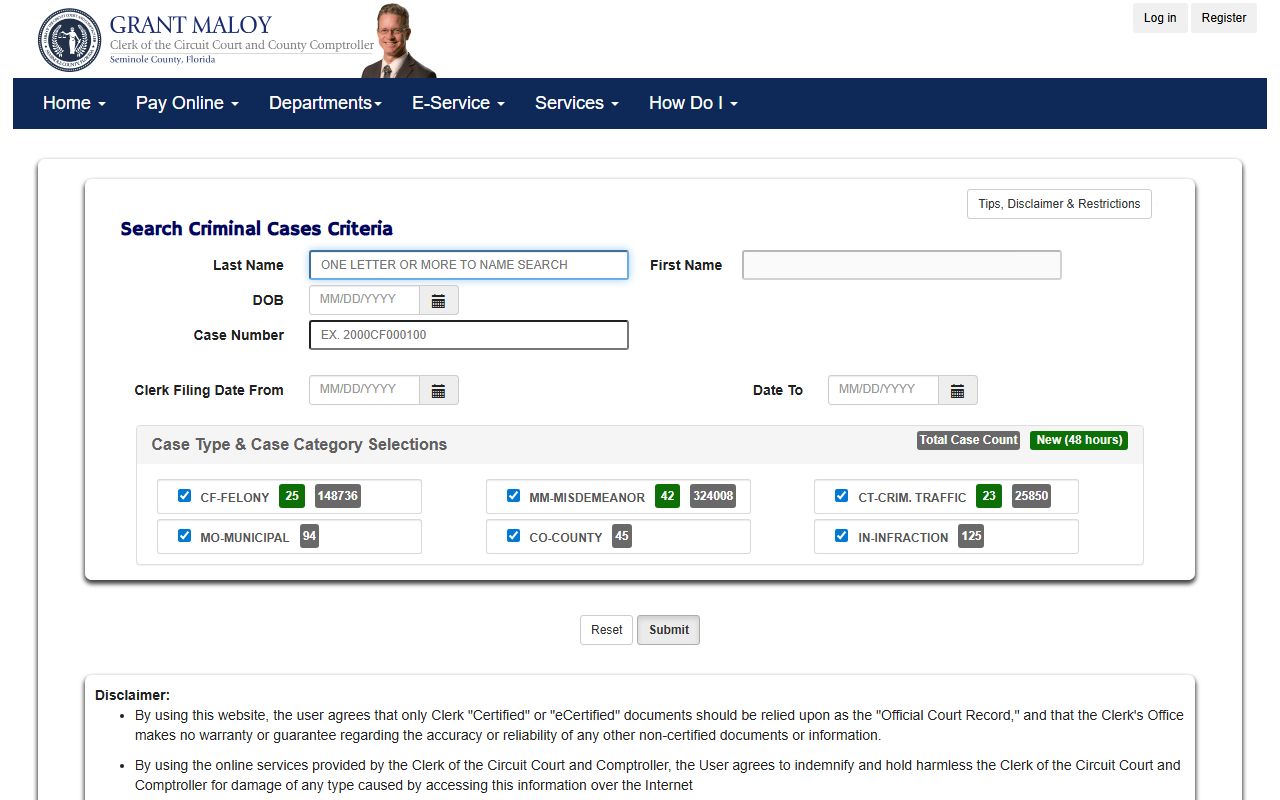
- Open the Clerk's criminal case portal from the Search for a Court Case page.
- Enter a last name and first name, or a case number for one file.
- Add a date of birth or filing-date range to narrow results.
- Check the category boxes you want, such as felony or misdemeanor.
- Open the case to read charges, hearings, and the disposition.
Felony and Misdemeanor Filters
The criminal portal splits cases into six categories, and each box can be turned on or off. The labels are the safest local vocabulary to use, because they match the Clerk's own system. Felonies are Circuit Court matters; the rest are county-level.
| Category | Code | Court Level |
|---|---|---|
| Felony | CF | Circuit Court |
| Misdemeanor | MM | County Court |
| Criminal Traffic | CT | County Court |
| Municipal | MO | County Court |
| County | CO | County Court |
| Infraction | IN | County Court |
A Seminole case number shows the level too. The portal's sample format, 2000CF000100, packs the year, the CF felony code, and a sequence number into one string.
Arrest Records Versus Court Records
This is the most important point on the page. An arrest record and a court record are not the same thing. The Sheriff's custody portal shows arrest and booking information only. Its own disclaimer says the data may not reflect the State Attorney's charging decisions or the trial outcome, and that final dispositions must be obtained from the Clerk. So a booking is the start of a story, not the end.
The Sheriff's office, shown below at the Seminole County Sheriff's Office site, links the custody portal and records requests.
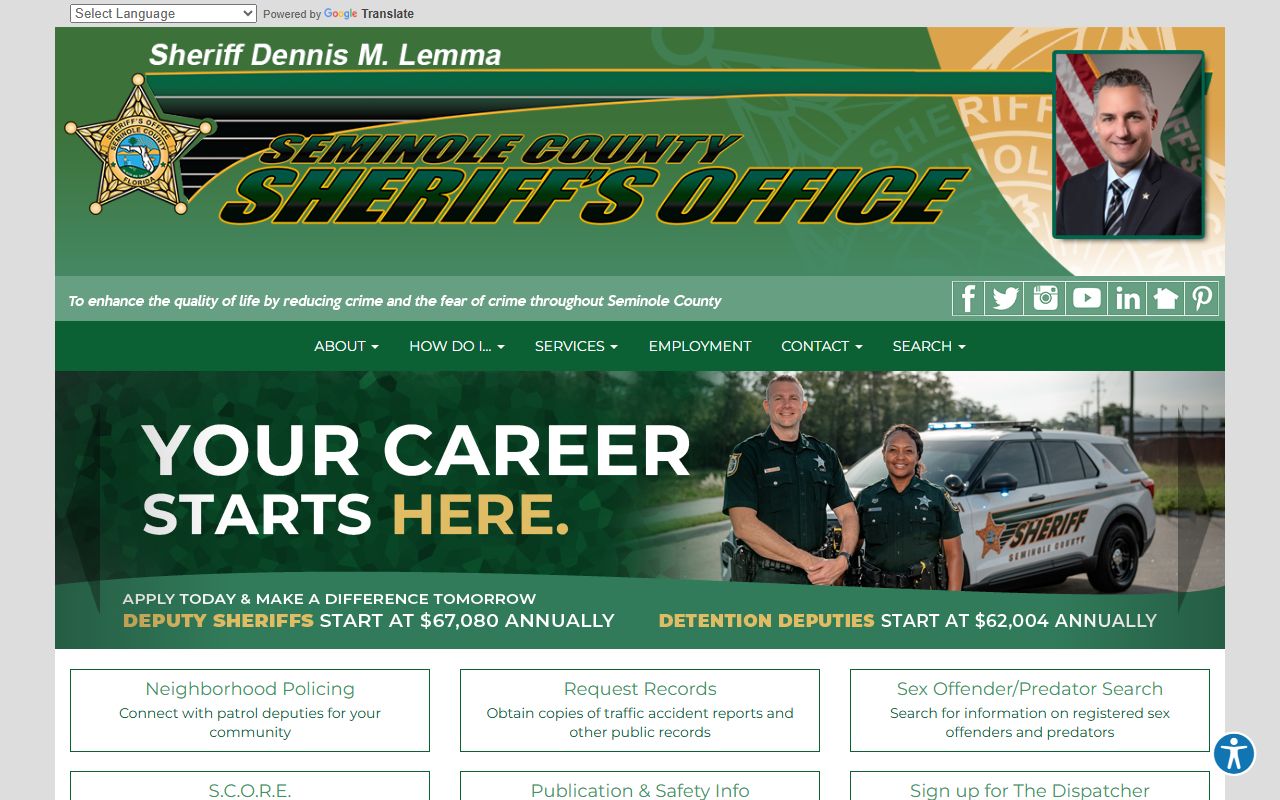
For the full custody search and booking fields, see the Seminole County inmate records page.
Charges Versus Convictions
People read criminal records wrong when they treat a charge as a conviction. A charge is an accusation. A conviction is a final ruling of guilt by the court. Florida also allows a judge to withhold adjudication, which avoids a formal conviction in some cases. The chart below sets out the difference.
| Point | Charge | Conviction |
|---|---|---|
| What it is | An accusation filed against a person | A final court finding of guilt |
| Where it shows | Arrest record and case filing | Case disposition in the Clerk record |
| Final? | No, the case is still open | Yes, unless appealed or vacated |
| Outcomes | May be dropped, reduced, or dismissed | Sentence, probation, or fine ordered |
Always read the disposition before you draw a conclusion. A charge marked nolle prossed means the prosecutor dropped it, and that is not a conviction.
First Appearance and Bond
After an arrest, the accused is seen by a judge at first appearance, usually within 24 to 48 hours if they have not bonded out. These hearings are held at the John E. Polk Correctional Facility in courtroom J-2. Workday hearings run at 2:00 PM, while weekend and holiday hearings are at 9:00 AM. Initial bond amounts follow a schedule set by administrative order.
Bond details appear on the Sheriff's custody profile. The portal warns that a $0.00 bond can mean no bond is due, the person was released, or the person was sentenced. If any single charge is listed as no bond, the person is not bondable on that charge. Confirm bond before paying anything.
Who Prosecutes Seminole Criminal Cases
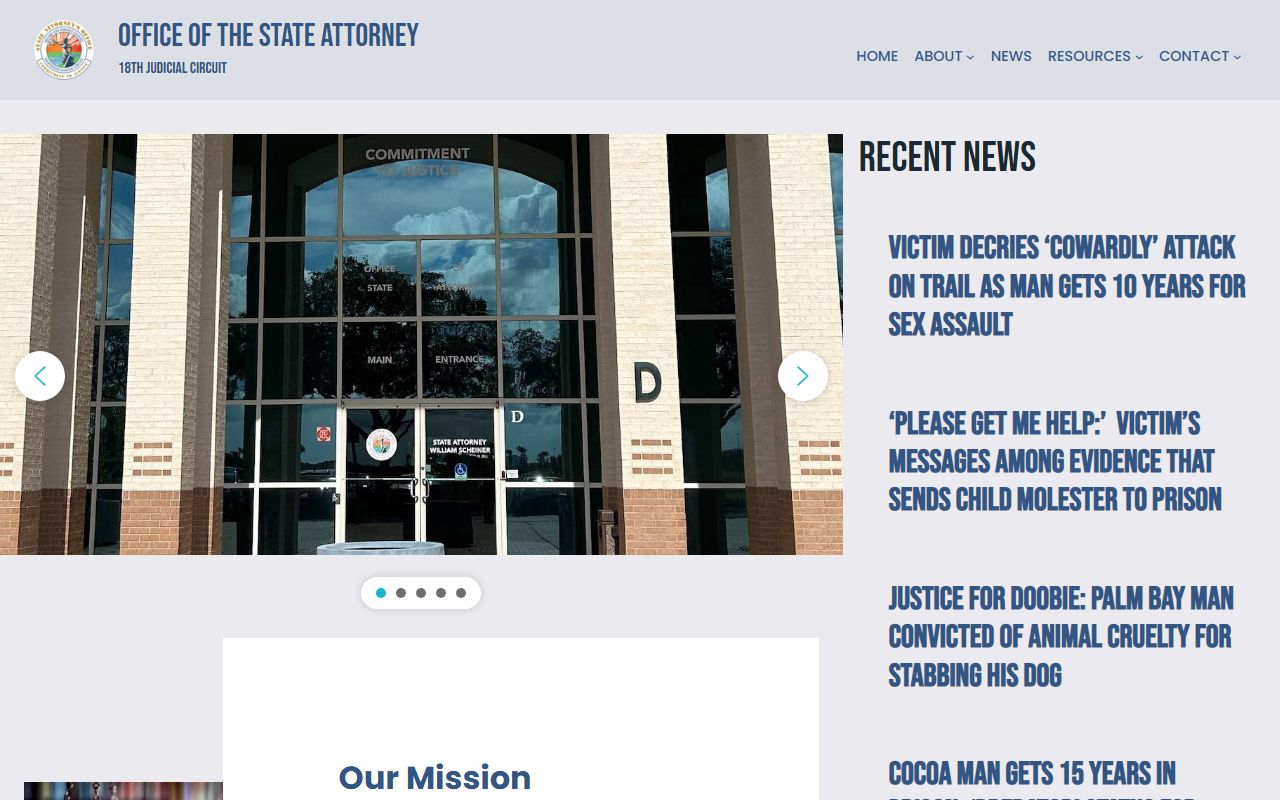
Florida uses the title State Attorney, not District Attorney. The Office of the State Attorney for the Eighteenth Judicial Circuit prosecutes criminal cases in Seminole and Brevard Counties. The office decides which charges to file after an arrest, which is why the Sheriff's booking data may not match the final case. The State Attorney also runs victim services, victim impact statements, and public records requests.
You can reach the office through the Eighteenth Circuit State Attorney site, which keeps a Sanford office for Seminole matters.
FDLE Statewide Criminal History
The Clerk portal only covers Seminole County. For a statewide criminal history, use the Florida Department of Law Enforcement. The FDLE Computerized Criminal History search at cchinet.fdle.state.fl.us is an official paid check that covers Florida arrests and dispositions across counties. It is the right tool for a broad background check rather than a single-county search.
FDLE also runs the state sex offender and predator registry. A full national or federal record needs other tools, since federal cases are not in any state system.
Sealing and Expunction in Seminole County
Florida lets some people seal or expunge an eligible record, but it is not automatic. Sealing restricts public access while keeping the record for certain agencies. Expunction more fully removes the public record, subject to statutory exceptions. The two are governed by Florida Statutes 943.0585 and 943.059.
| Point | Sealing | Expunction |
|---|---|---|
| Effect | Restricts public access, record kept | Removes the public record more fully |
| Who can still see it | Certain agencies by law | Limited agencies under statutory exceptions |
| Process | Eligibility review, petition, court order | FDLE certificate, petition, court order |
A conviction, an ineligible offense, a prior sealing or expunction, or a pending charge can disqualify a person. After an order is signed, agencies and the Clerk still need time to process it, so a record may stay visible for a while.
What a Seminole Criminal Record Shows
A criminal case record holds a fixed set of fields. Reading them in order tells you the whole arc of the case, from booking to disposition. The Sheriff custody profile and the Clerk case file each add their own pieces.
| Field | What It Shows |
|---|---|
| Name and Booking Number | The person and the booking that opened the jail record. |
| Arresting Agency | The Sheriff or a city police department that made the arrest. |
| Charge and Class | The offense and whether it is a felony or misdemeanor. |
| Court Case Number | The Clerk file tied to the charge. |
| Bond Type and Amount | The bond set, or a no-bond status. |
| Next Court Date | The next scheduled hearing for the case. |
| Disposition | The current or final outcome of each charge. |
A blank or "Not Filed" disposition simply means the State Attorney has not yet made a charging decision on that line.
Warrants and Capiases
Open warrants are part of the criminal picture. An arrest warrant is issued on probable cause. A bench warrant or capias is issued for a missed court date or contempt. A violation-of-probation warrant follows an alleged probation breach. Seminole did not publish a standalone public warrant list, so the best path is the Clerk criminal portal and the Sheriff custody portal, plus a call to counsel or the court.
More detail on warrant types and how to clear one sits on the Seminole County warrant records page. For DUI and other driving offenses, see traffic court records.