Florida Uses Circuit Courts, Not District Courts
A quick note on names. Florida does not use a trial-level district court the way some states do. Its trial courts are the Circuit Court and the County Court. The phrase "district court" in Florida refers to the District Courts of Appeal, which are appellate courts. So in Seminole County, the trial court for serious cases is the Circuit Court, and that is the term to use.
This matters when you search. People who expect a "district court" in Florida are really looking for the Circuit Court or the County Court, depending on the case. Picking the right court name up front keeps a records search from stalling on a term Florida does not use.
The Eighteenth Judicial Circuit
Seminole County sits in the Eighteenth Judicial Circuit, which the Legislature created in 1967 and which also covers Brevard County. Florida has 20 circuits in all. Each circuit court is a court of general jurisdiction, handling the cases that county courts cannot. The circuit's administration office for Seminole is at the Civil Courthouse on North Park Avenue in Sanford.
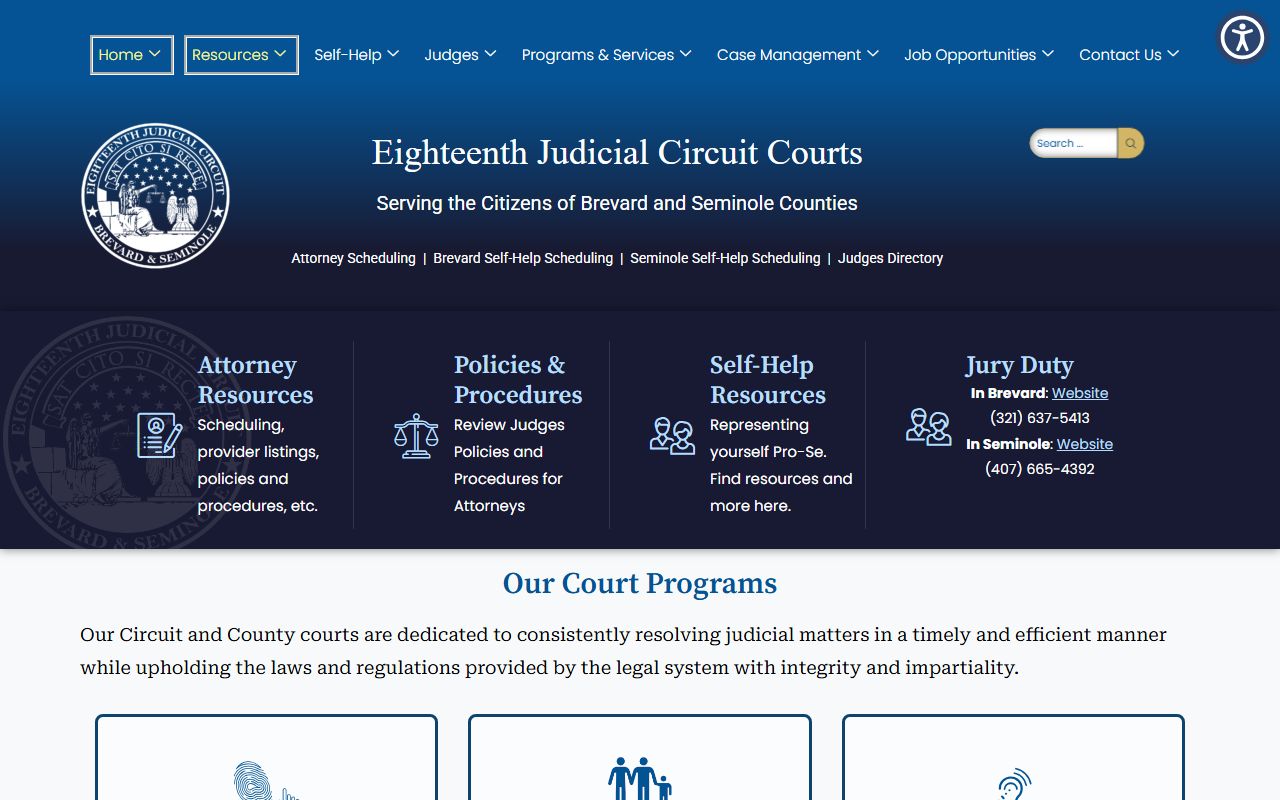
The Eighteenth Circuit's site, shown below from the Eighteenth Judicial Circuit page, serves both counties.
Circuit Court Jurisdiction in Seminole County
The Circuit Court hears the heavy cases. Its jurisdiction includes felony criminal cases, civil actions over $50,000, family law and dissolution of marriage, probate and guardianship, juvenile matters, mortgage foreclosures, injunctions, and adoptions. It also hears appeals from the County Court and certain administrative decisions assigned by law. In short, the most serious or highest-value matters go to the Circuit Court.
The Florida Courts structure page, shown below from the Florida court structure page, maps the circuit court's place in the system.
Circuit Court Versus County Court
The two trial courts split the work by seriousness and value. The Circuit Court is the general court for major matters. The County Court is the limited court for smaller ones. The chart below shows the divide, which decides where a case is filed and which portal holds it.
| Point | Circuit Court | County Court |
|---|---|---|
| Criminal | Felonies | Misdemeanors, criminal traffic |
| Civil | Over $50,000 | Up to the county-court limit |
| Family / Probate | Dissolution, probate, guardianship | Not handled here |
| Other | Juvenile, injunctions, appeals from county court | Small claims, evictions, traffic |
For the limited court, see the Seminole County Court page. For the case files themselves, see court records.
Seminole County Court Locations
Court functions are spread across the Sanford justice campus. Circuit and county criminal and civil counters run from the Criminal Justice Center during the renovation, injunctions and administration sit at the Perry Annex, and probate and juvenile services are at the Juvenile Justice Center. Court administration for the circuit is at the Civil Courthouse.
| Court Function | Location | Phone |
|---|---|---|
| Court Administration | 301 N. Park Avenue, Sanford | 407-665-4200 |
| Criminal and Civil Counters | 101 Eslinger Way, Sanford | 407-665-4300 |
| Injunctions and Administration | 91 Eslinger Way, Sanford | 407-665-4300 |
| Probate and Juvenile | 190 Eslinger Way, Sanford | 407-665-4369 |
| Official Records | 1750 E. Lake Mary Blvd., Sanford | 407-665-4405 |
During construction, Tuesday through Thursday traffic hearings moved downtown to 301 North Park Avenue, while Friday hearings stay at Eslinger Way.
How a Case Moves Through the System
A case follows a clear path up the court system. Knowing the path tells you where a record lives at each stage.
Case flow: County Court › Circuit Court › District Court of Appeal › Supreme Court of Florida
A misdemeanor or small civil case starts in the County Court. A felony or large civil case starts in the Circuit Court. An appeal from a circuit trial goes to a District Court of Appeal, and the Supreme Court of Florida sits at the top with final review and statewide court administration.
Appeals From the Seminole Circuit Court
Appeals follow Florida's statutory structure. A County Court decision can be reviewed by the Circuit Court, while a Circuit Court trial decision is reviewed by a District Court of Appeal. The Supreme Court of Florida has final authority, with discretionary and mandatory jurisdiction set by the constitution and statute.
Federal matters are separate. Cases under federal law from Seminole County go to the U.S. District Court for the Middle District of Florida, not the Circuit Court. For those, see the federal court resources rather than the Clerk portals.
An appeal is not a retrial. The higher court reviews the record and the legal rulings rather than hearing the case fresh. That is why the trial-court file, kept by the Clerk, stays the core record even after an appeal is filed.
Circuit Court Divisions and Records
The Circuit Court is organized into divisions that match the work it does. The criminal division handles felonies. The civil division handles large money and property disputes. The family division handles dissolution, support, and paternity. The probate division handles estates and guardianship. Each division produces its own records, and the Clerk indexes them under matching case-type codes.
When you search, the division code in the case number points you to the right place. A CF code is a felony in the criminal division, while family and probate codes route to those divisions. Reading the code first saves time, because it tells you which portal category to check.
History of the Seminole Circuit Court
The Eighteenth Circuit was created in 1967. Before Florida's 1972 court reform, the area used many court types, including a Court of Record, a Magistrate's Court, County Judge's Courts, Justice of the Peace Courts, and a Small Claims Court. After 1972, the state simplified its trial courts into the circuit and county model still in use. The Justice James E.C. Perry Annex is named for a former circuit judge who later joined the Florida Supreme Court.
That history matters for old records. A very old docket may name a court that no longer exists, which is normal for files from before the reform. When a record is that old, the Clerk can tell you whether it sits in archives or on microfilm rather than online.
Veterans Treatment Court
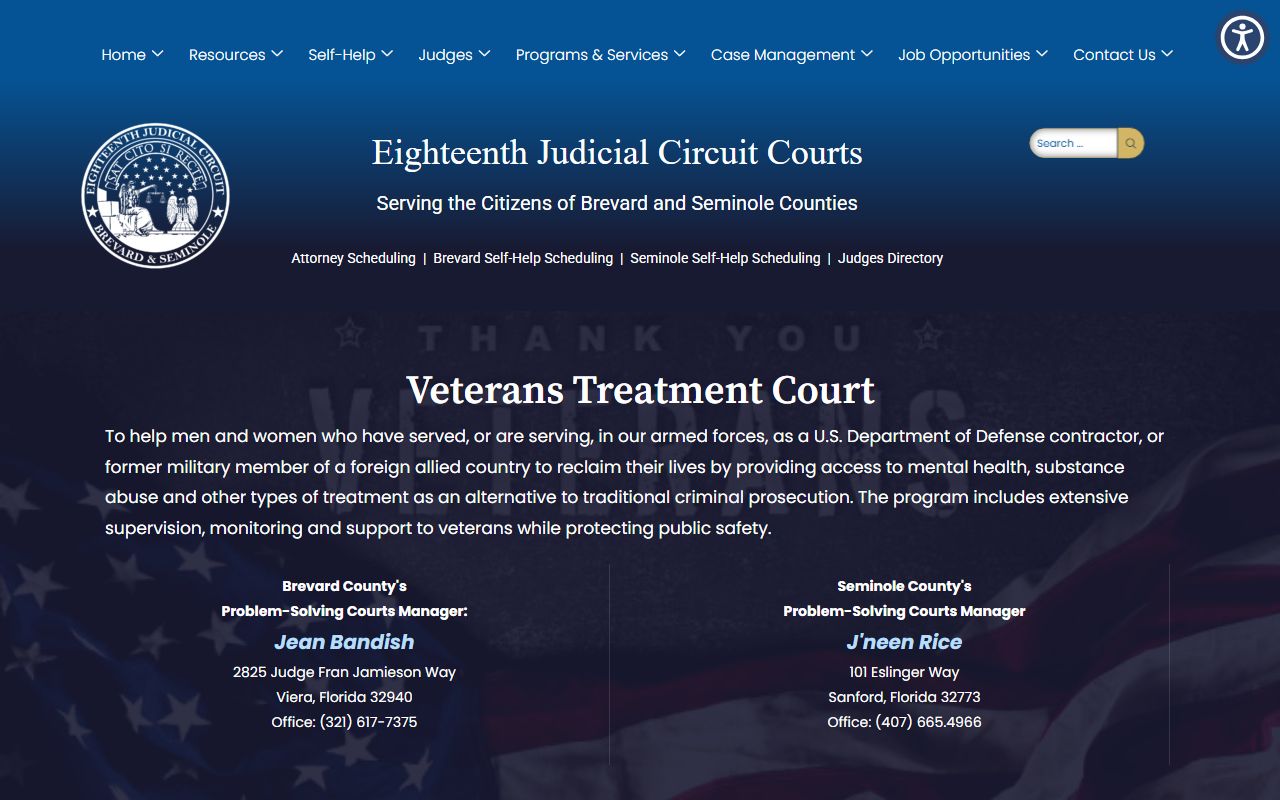
The Circuit Court runs specialty programs, the best documented being the Veterans Treatment Court. It began as a Seminole pilot in 2012 and steers eligible justice-involved veterans into treatment instead of the usual path, across three phases. On successful completion, the plea is withdrawn and the State Attorney drops the charge.
The Eighteenth Circuit's Veterans Treatment Court page, shown below, lists the criteria and contacts.